
· Tom
Young Players At International Level – How Many Go On To Earn Senior Caps In Europe?
Recently Bayern Munich and Portuguese wonder kid Renato Sanches was crowned European Golden Boy for 2016, beating the likes of England’s Marcus Rashford and France’s Kingsley Coman to the award. At TSZ this led us to ask the question – which country is producing the most young players in Europe?
To explore this, we have decided to look at the UEFA European under-17, 19 & 21 Championships (since 2002 due to the reformatting of the current age groups) to determine which countries rank the best in the age groups. In doing this we will also be able to look at players developing from the respective age groups through to the senior team, i.e. the percentage of players from the senior team playing in European Championship action (both qualifying and tournament) that have represented their national team at the under-17, under-19 and 21 age groups. The data used will be from 1st January 2000.
We have used the following criteria when ranking team performance in each respective age group:
Winners = 5 points
Runners up = 3 points
Semi Finalists = 2 points
Qualification for Tournament = 1 point
UEFA European Under-17 Championship
The UEFA European Under-17 Championship is a tournament held every year. The under-17 national teams of the member associations of UEFA compete in qualification rounds for the right to earn a place in the finals (please note in 2002, 2015 and 2016 there were 16 tournament places available, whilst there were only eight every other year).
First up, we will look at the top 10 countries in the competition since 2002 using the ranking system explained above. The table below will also show the percentage of players who have progressed from under-17 level to representing their senior team at either the European Championships or the relevant qualification campaign.
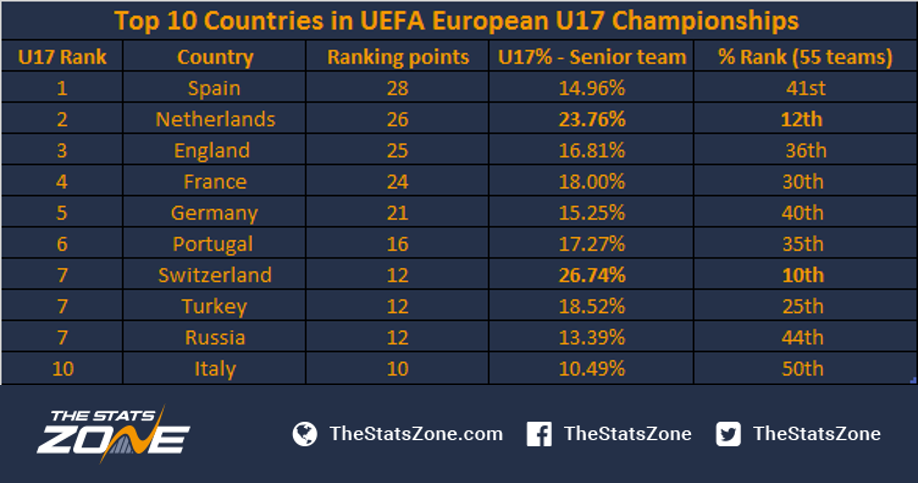
- At under-17 level a lot of the big countries you’d expect to be competing at the highest level are inside the top 10, with Spain topping the list having won the tournament twice since 2002 (2007 and 2008). They are closely followed by Netherlands in second place and England in third place who have enjoyed decent success at this level despite the failings of the senior side. Turkey are perhaps a surprise name on the list but have won this tournament back in 2005 as well as making two other semi-final appearances.
- When we look at the percentages of players who went on play for their senior team at these successful under-17 sides, it is slightly surprising to see how low the numbers are; only Switzerland and Netherlands rank inside the top 15 out of 55 countries.
Which countries’ senior team players have represented their under-17 national team the most?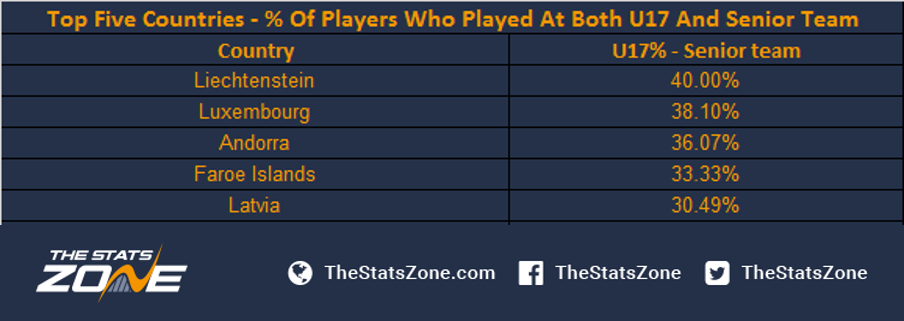
- This is where the lesser ranked nations make the top of the list; 40% of senior team players that have represented Liechtenstein in European Championship action have played a part in the national side at under-17 level. They are closely followed by other lesser ranked rations in Luxembourg, Andorra, Faroe Islands and Latvia who round out the top five.
- Players representing their country at under-17 level for one of these smaller nations have a better chance of representing their senior side one day when compared to bigger countries such as Russia and Italy, who rank 44th and 50th respectively.
UEFA European Under-19 Championship
The UEFA European Under-19 Championship is a tournament held every year and sees eight qualified teams compete for the prize. The above ranking system will be followed; however in 2002 there was no semi-final, only a third place play off so in this instance these two teams will be awarded semi-final points.
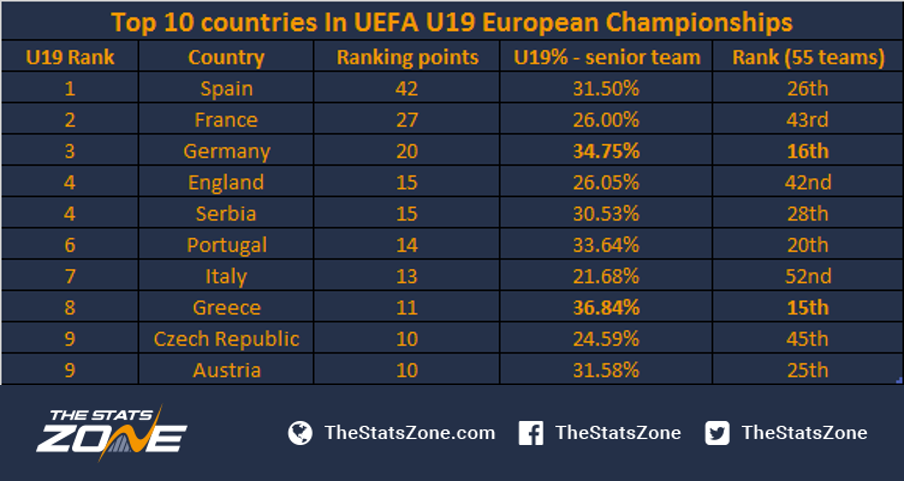
- Since 2002, Spain have been a dominant force at under-19 level as they again top the table. Countries such as France, England, Germany and Portugal continue to figure in the top 10; however, Netherlands who were 2nd in the under-17 table drop out of the top 10 into 17th place.
- The surprise nation this time around are Serbia who have performed equally as well as England since 2002; the Serbians even won the tournament in 2013 with current Newcastle United striker Aleksandar Mitrovic the star player.
- The two teams in the top 10 with the highest percentage of players going on to feature for the senior side in European Championship action are Greece and Germany.
Which countries’ senior team players have represented their under-19 national team the most?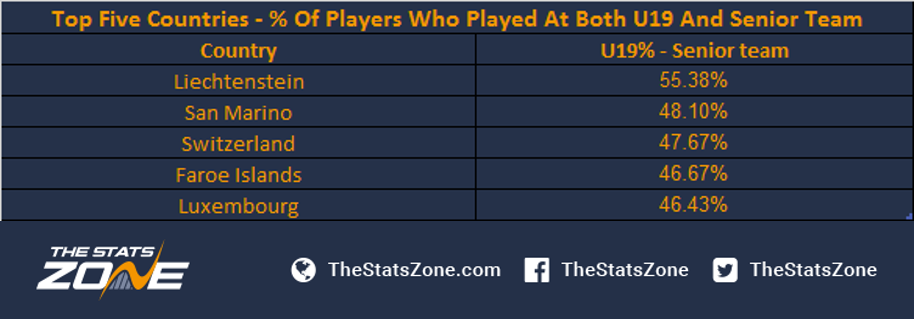
- Yet again we see the lesser ranked nations featuring highly with Liechtenstein topping the list once more. Notably, we have one so called bigger team featuring in the top five in Switzerland. When we look back at under-17 level we see they featured in 10th place but they have not been able to mirror their success at under-17 level in the under-19 age group, where they are ranked 19th compared to joint 7th in the younger age group.
UEFA Under-21 European Championship
Unlike the under-17 and under-19 Championships, the under-21 Championships are held every two years, with eight teams competing for the prize.
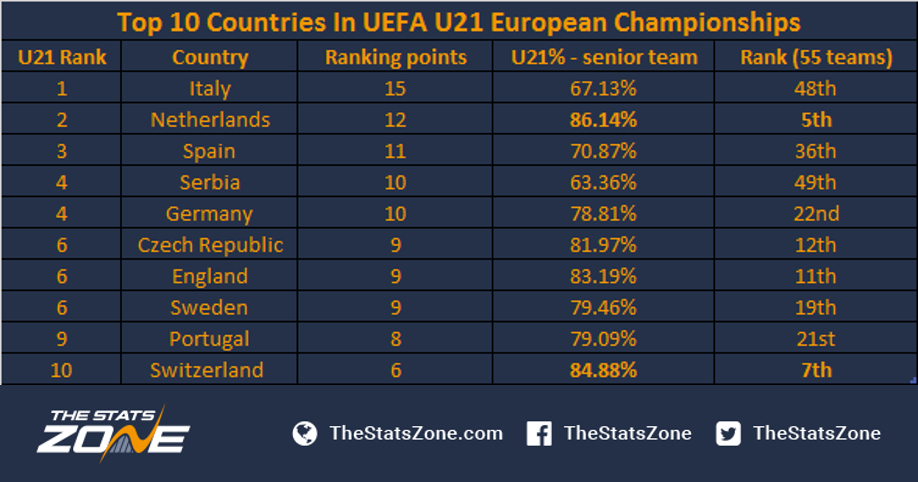
- Spain have finally surrendered top spot at under-21 level and have to settle for third place; they show a lack of consistency since 2002, only qualifying for the tournament on three occasions but have won twice with a strong showing in 2011 and 2013, where the likes of Thiago Alcantara, Alvaro Morata and Juan Mata starred.
- Top spot this time around goes to Italy; they have shown a good level of consistency since 2002, qualifying for all but one tournament and winning the competition back in 2004 and finishing as runners-up in 2013. Netherlands show a resurgence in the under-21’s, claiming 2nd spot having been outside the top 10 at under-19 level
- Of the teams that have performed well at under-21 level, Netherlands and Switzerland also rank highly in terms of senior players having played a part at under-21 level, ranking 5th and 7th respectively.
Which countries’ senior team players have represented their under-21 national team the most?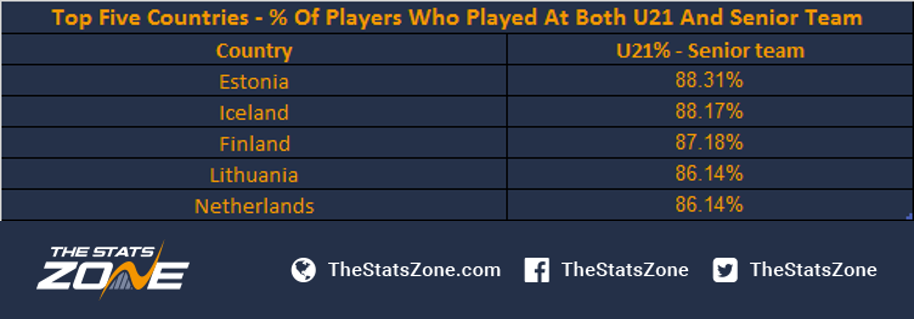
- What is noticeable here is the emergence of two Scandinavian nations in Iceland and Finland; their senior teams have put a great deal of faith in players they have nurtured through the under-21 system.
Throughout the course of the analysis we looked at the percentages of senior team players who have represented their countries at younger age groups; however, how does the top 10 look when data from the three age groups is combined?
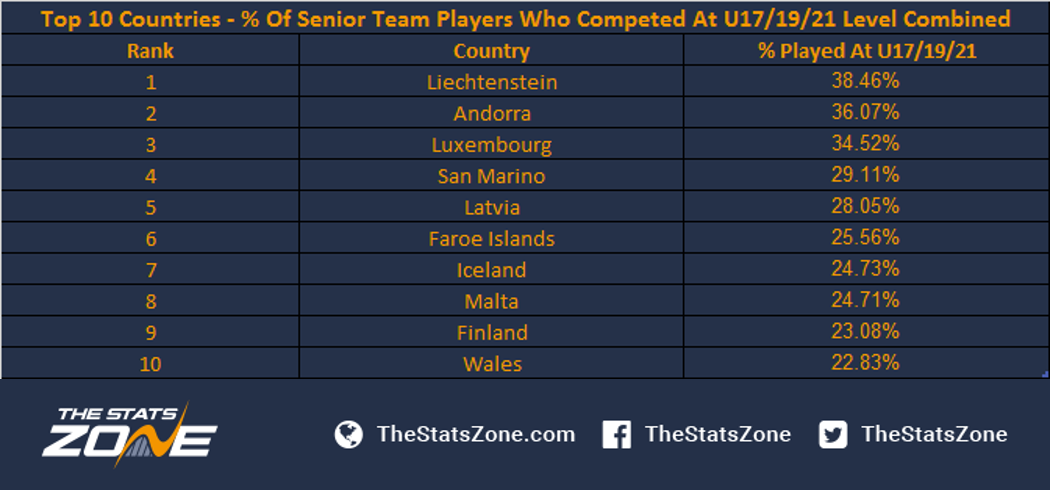
- Despite not featuring in the top five at under-21 level, Liechtenstein topped both the under-17 and under-19 tables. This sees them as the nation who have used the highest percentage of players at senior level in the European Championships (both qualifying and tournament if applicable) that have played a part in the under-17/19/21’s when combined together.
- Two of the surprise packages at Euro 2016 make an appearance with Iceland in 7th place and a home nation in Wales popping up in 10th when all the data from the three age groups has been combined.
Players who represent their countries at these age groups are on the right track but they need to keep their head down and work hard to ensure caps for the senior side will follow in the coming years. Using the data from the 55 European teams we can see the percentages of players that have represented their country in European Championship action (both qualifying and in tournament) for the senior side that have also represented their country in the younger age groups.
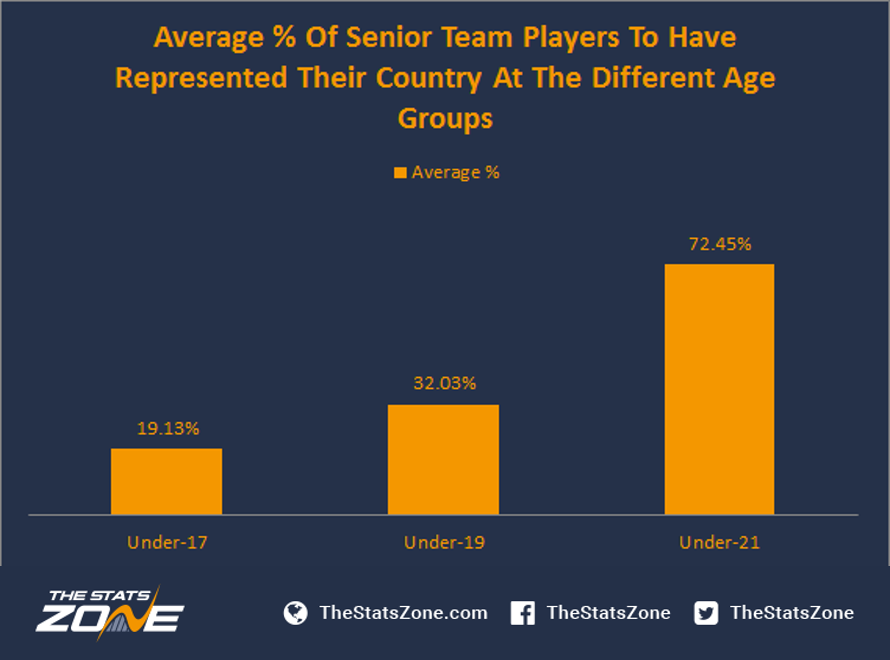
- There is a significant rise in each of the age groups with just 19.13% of senior players from the 55 nations representing their country at under-17 level and then a jump to 32.03% at under-19 level.
- Representing your country at under-21 level is a good indicator for a senior cap to follow, with 72.45% of players who have played at senior level also representing their country at under-21 level.
Caps at youth level for your national side doesn’t necessarily pave the way for caps at senior level. Even though on average 72.45% of players to have played at senior level have represented their country at under-21 level, the fortunes of players from different countries can still be very different. A quick look back at the 2009 European under-21 Championship final of 2009 between England and Germany will show the differing pathways of players.
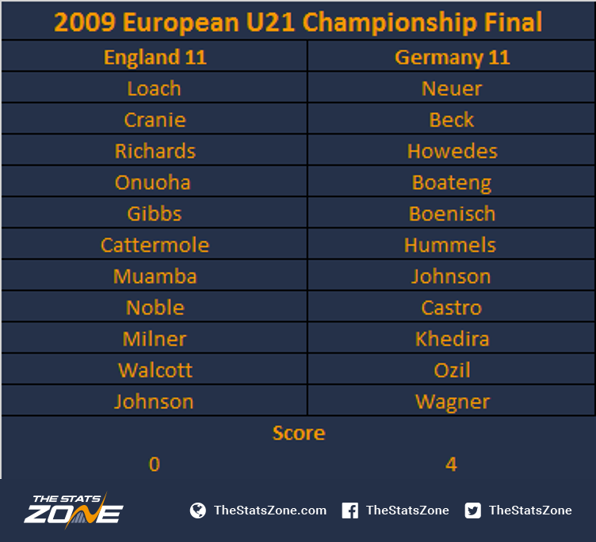
Germany beat England 4-0 that day but the differing fortunes of the players in either team’s starting 11 is staggering. All but one player from Germany has been capped at International level, whilst six of that starting 11 (Neuer, Howedes, Boateng, Hummels, Khedira and Ozil) were part of the successful World Cup winning squad in 2014. Six of the starting 11 for England have failed to earn a senior cap (Scott Loach, Martin Cranie, Nedum Onuoha, Fabrice Muamba, Lee Cattermole and Mark Noble) with only Kieran Gibbs, James Milner, Theo Walcott and Adam Johnson making some sort of progress with the senior side.
To conclude, we have established that in the younger age groups at national level, Spain are the team to beat; they top the charts in both the under-17 and under-19 level but are not so dominant at under-21 level where they ranked third. There were a few surprises with Turkey impressing at under-17 and Serbia at both under-19 and under-21 since 2002. The lesser ranked and smaller nations such as Liechtenstein and Andorra have shown a greater reliance on using players they have been nurtured through the youth systems, although these nations have a much smaller pool of players to choose from so this is hardly surprising. Clearly, not gaining a cap at under-17 level doesn’t seem to overly damage your chances of receiving a senior call up later in your career, whereas whilst representing your country at under-21 level sees your chances of receiving a senior call up significantly enhanced.


