
· Tom
Tour De France – Is The Doping Reputation Justified?
British Cycling has undergone a massive restructure in recent years, which has led to some significant results. Chris Froome – the British reigning champion of Tour De France (TdF) – is one obvious example, looking very likely to win his third title with just four stages left of the race (as of 20/07/2016). The TdF is one of the most prestigious competitions in cycling and also considered one of the most demanding endurance events in sporting history, but its reputation has been shaded in recent years by doping scandals involving the performance enhancing illegal substance, EPO (known as erythropoietin).
In an effort to prevent this from ruining the credibility of this world renowned competition, the International Cycling Union (UCI) has worked alongside governmental bodies to establish rules and policies around the competition. Following our recent analysis into the legitimacy of world record in athletics, TSZ will explore the impact that doping has had in TdF in recent years. Specifically, we want to look at the proportion of top cyclists that have tested positive for doping and what countries they come from. We also want to identify if there is a positive correlation between those who perform best in the competition and those who have tested positive for doping. Finally, we want to determine if the rules and regulations implemented in recent years by the UCI and governmental bodies have had the desired effect of reducing the number of doping cases in the competition.
There were a few considerations in this analysis. Firstly, the data used was collected from TdF Data and includes the top 10 finalists between 1998 and 2015. Secondly, the final two sections of the analysis look at finishing place and the year-on-year doping development. We appreciate that it is possible that the same rider could be accounted for numerous times if they have finished in the top 10 more than once. Thirdly, when we refer to doping we have included all cyclists that have either categorically tested positive, or have publically admitted to the use of EPO, albeit without having tested positive. All other cyclists are treated as “Not Tested Positive” even though there might be strong suspicions.
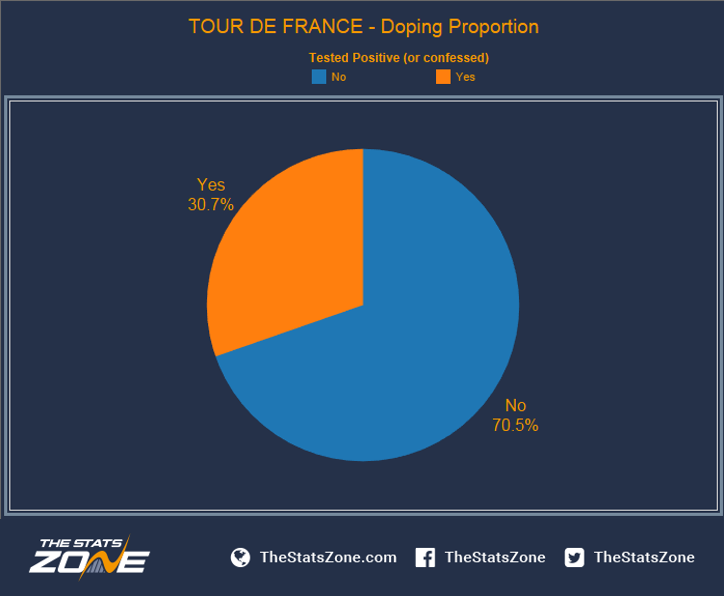
As a starting point, we will look at the proportion of cyclists who have tested positive for doping out of the total study. This is visualised through a pie chart, which allows us to easily spot any differences. Following this, we want to identify if there are trends in the nationality of the cyclists using performance enhancing drugs. Delving further into the data, we will seek to find if there is a correlation between top ranking cyclists and doping scandals. The final section of this analysis looks at trend lines through the entire time series of the data to see if the development of prevention of doping is moving in the right direction. Looking at the pie chart below, we can see that a shocking 30.7% of cyclists in this data set tested positive for doping. This gives us a clear indication that there has been or still is a problem in cycling, but where does this illegal use take place?
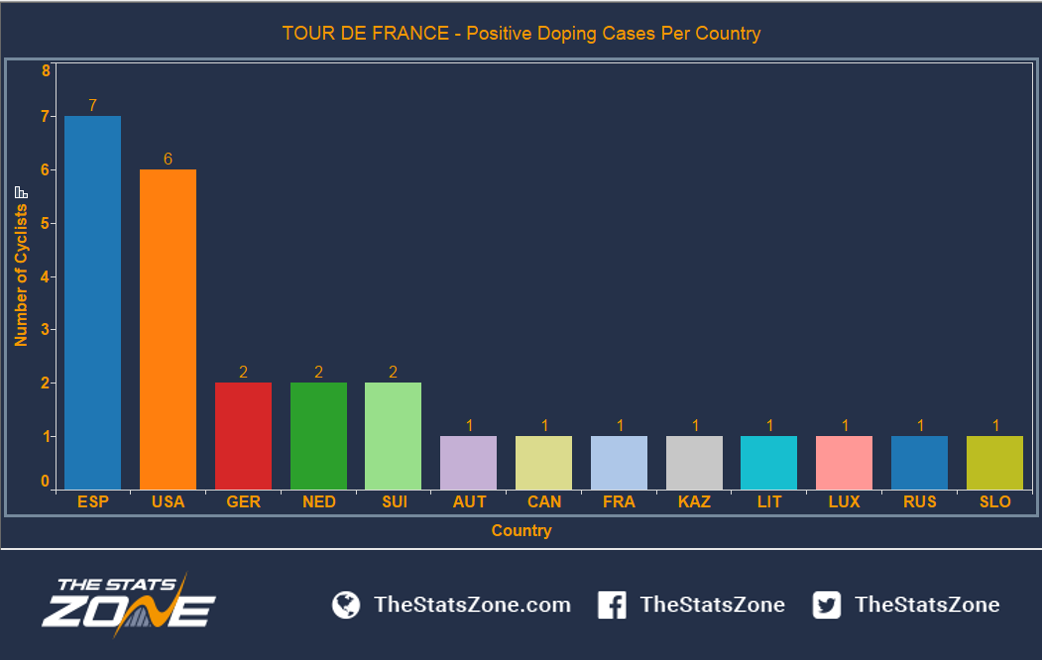
The second graph below shows positive doping cases per country. Here we can see that Spain (ESP) has the highest number of positive doping cases at seven. A look into the raw data shows that Spain has 19 participants, significantly higher than any other nationality. This essentially means that 36.8% of Spanish cyclists have tested positive for doping, sitting above the average of 30.7% (as demonstrated in the pie chart above). The USA, with the second most number of participants (10), show a remarkable rate of total doping cases at six or 60%. Before we move on, we would like to point out that Spain and USA added together account for almost half of all doping cases in our dataset.
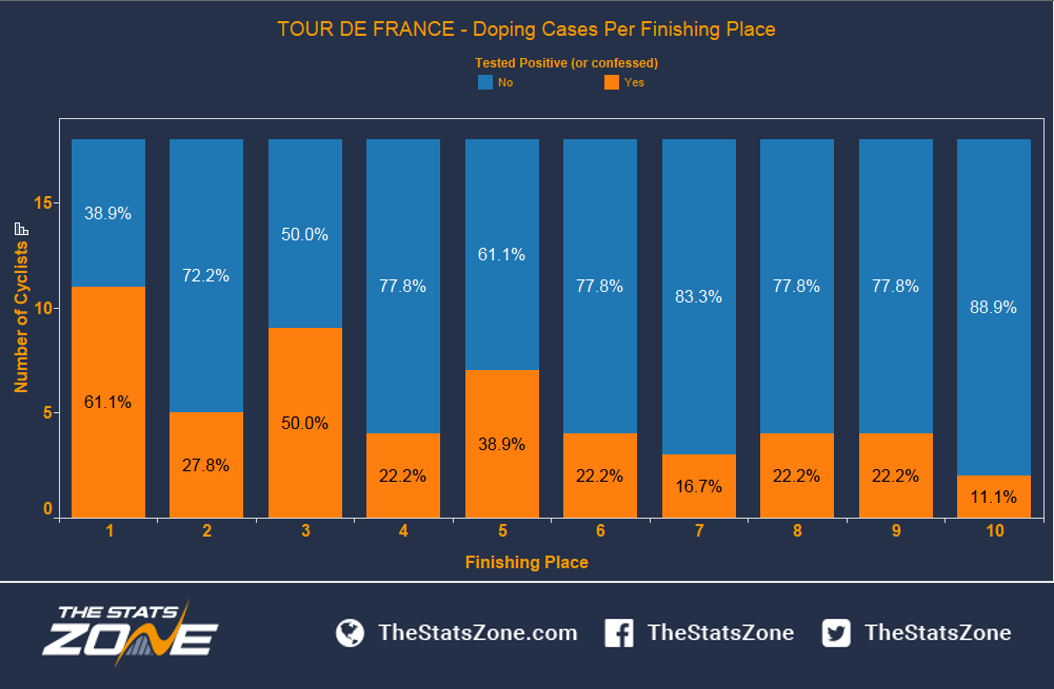
The third graph demonstrates the proportion of doping cases per each respective finishing position. Here we can see that a remarkable 61.1% of TdF winners have consequently tested positive for doping. Looking through the series we can see an even split for third place (50% vs. 50%). The lowest number of doping cases have been recorded by those who finish 10th at 11.1%. Therefore, it’s clear that there seems to be a correlation between the proportion of cyclists who have tested positive for doping and the highest ranking positions in the competition.
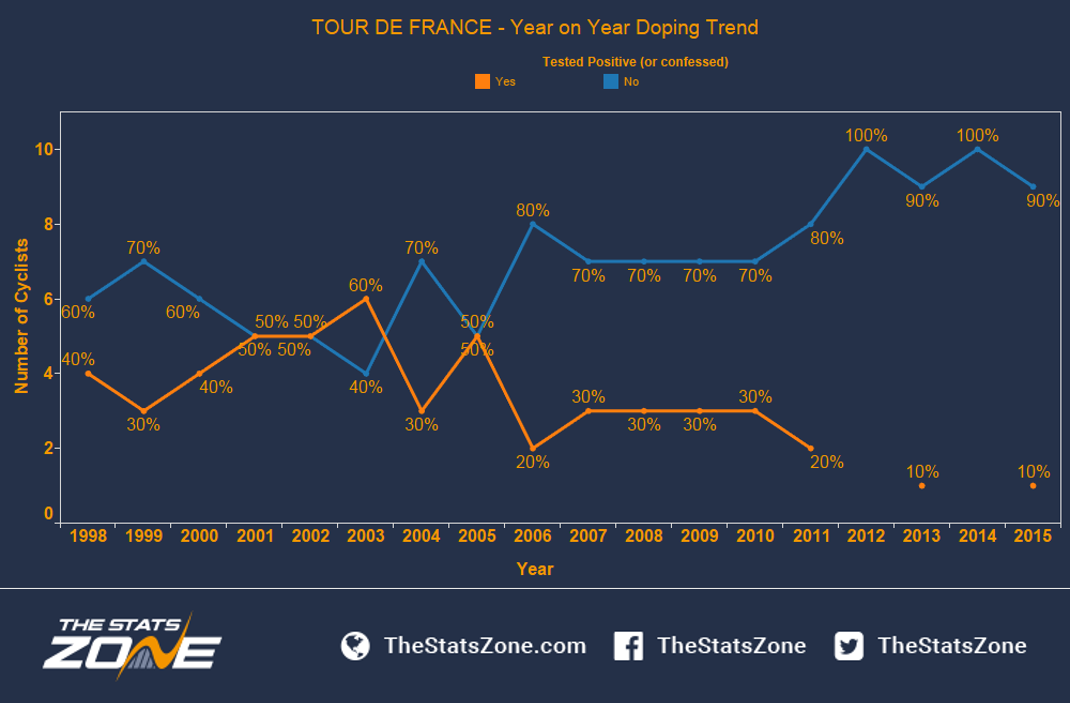
The last graph illustrates a trend line of the number of cyclists who have been caught doping vs. those who have not. Looking at the early stages in the graph (from 1998 to circa 2003), we can see an irregular pattern in the number of cyclists caught doping, ranging between 30%-60%. After this, the line representing the cyclists who haven’t been caught doping goes up significantly, whilst the opposite occurs for those who tested positive. This demonstrates that the number of cyclists using illegal substances from 2004 onwards has decreased significantly. What’s also remarkable is that there wasn’t a single positive doping case in the top 10 cyclists in 2012 or 2014. Tying this back into the previous graph, we can clearly see that the majority of situations where the highest ranking cyclists have tested positive come from the earlier years in the dataset. A closer look into the raw data confirms this, with all winners since 2011 maintaining a clean doping record.
To conclude, it is clear that cycling – specifically TdF – has endured a difficult history with doping over the years. A closer look at the data proved that Spain and USA has the highest proportion of cyclists using illegal performance enhancing drugs. Having said that, TSZ does point out that this could partly be attributed to the disproportionate number of participants in the competition who enter from these countries. As you would expect, we have seen a correlation between the use of doping and the winning cyclists. On the flip side, when looking at the lower ranking positions, we see the smallest percentage of doping cases. We do acknowledge the fact that there could well be more scrutiny on those who rank highest and this may play a part in these results. As a positive take-out, we have seen a significant drop in doping cases in TdF since 2004, with 2012 and 2014 standing out without a single cyclist being caught doping. So maybe TdF doesn’t deserve such a bad reputation after all?


