


· Tom
How much can the absence of natural full-backs affect Belgium during Euro 2016?
Belgium must be one of the most talented teams in the world, but the way Marc Wilmots sets up his side, particularly his back-four, remains perplexing to many.
Loaded with talent at both ends of the pitch, Belgium is certainly one of the favourites to win the European Championship in France this summer. They have two world-class goalkeepers, a ton of talented midfielders and a couple of clinical strikers that don’t need many chances. The Red Devils however, have a weak link in the defence - their absence of orthodox fullbacks.
To start, let’s analyse which players will be part of Belgium’s squad for the upcoming European Championship:
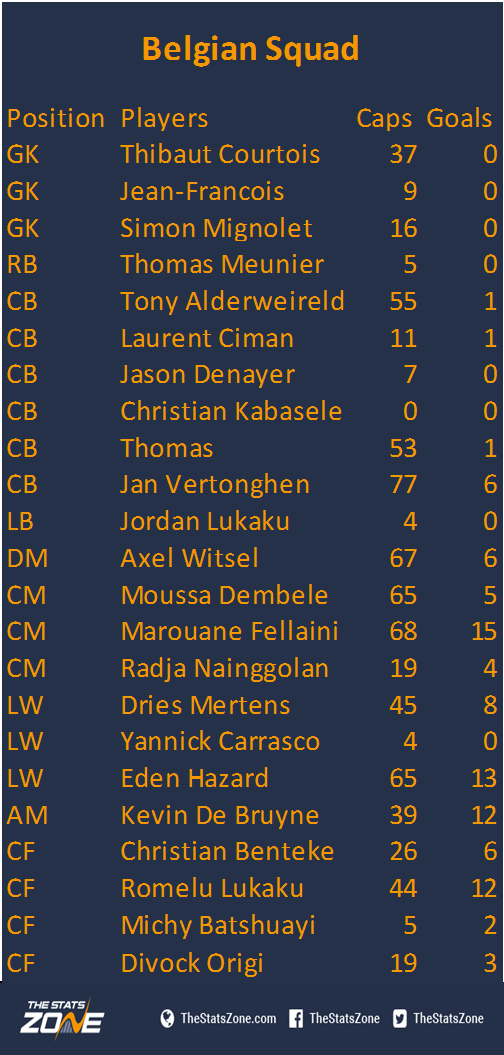
We can see it’s a very talented squad that combines rising stars like Michy Batshuayi, Yannick Carrasco and Jason Denayer with established players like Thibaut Courtois, Eden Hazard and Kevin de Bruyne, just to name a few. The lack of depth at the defensive end, particularly on the flanks, certainly stands out though. Wilmots has decided to carry only two natural fullbacks in the 23-man squad, and between them both (Thomas Meunier and Jordan Lukaku), they have just nine total caps for the national team.
We know Belgium plays with a 4-2-3-1 system and even though that can be morphed into a 4-3-3, Wilmots has always played with a four-man defensive line. The lack of specialists on the flanks has forced the manager to play – more often than not – with four central defenders at the same time.
The numbers support this theory: since Wilmots took over as manager of Belgium, these are the total starts made by every single player on the defensive line:
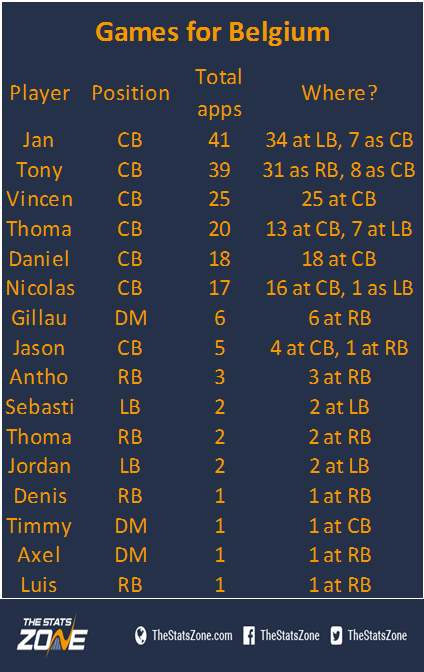
A total of 16 players have been used in defence: eight as CB, eight as RB and five as LB. Some players (like Thomas Vermaelen, Tony Alderweireld and Jan Vertonghen) have seen time in two or more roles. Others aren’t even defenders by trait. Three of the players listed here (Axel Witsel, Timmy Simons and Gillaume Gillet) are defensive midfielders that Wilmots has tried either in central defence or as right backs. The experiments, it must be noted, haven’t been successful.
Meunier and Lukaku have each once started twice during Wilmots tenure, and it’s pretty unlikely that they will have bigger roles in the tournament. Denayer and Alderweireld have seen time at RB and the latter has actually played more times on the flank instead of at his natural CB role. The same can be said for Vertonghen who, even though he’s played his whole career as a CB, has played 34 times as a left-back for Belgium in the past four years.
With that being said, which pairing has played together the most for Belgium under Wilmots’ tutelage?
Wilmots’ most repeated partnership was the one of Alderweireld, Kompany, Vermaelen and Vertonghen with 13 appearances. In those 13, Vermaelen played six times as a LB and Vertonghen seven. The latter is expected to be the team’s starting left back once Belgium kick off their European Championship quest against Italy this Monday. This aforementioned partnership has also played together at least once in each of the last four years, so there's some degree of consistency as well.
Barring an unseen catastrophe, it’s pretty likely that the starting defensive line for Belgium in their opener against Italy will have Alderweireld as the right back, Thomas Vermaelen and Denayer as centre backs and Vertonghen on the left side. It’s an imposing defence for sure, but it could be even better since both Vincent Kompany and Nicolas Lombaerts will miss the tournament through injury. Some teams might struggle when using four central defenders through the whole width of the pitch, but that’s not the case with Belgium.
Once again, the numbers support the theory. Belgium has been one of the most successful teams in the world over the past five years, and their record shows it:
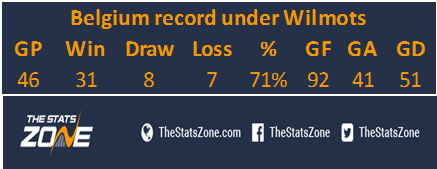
Aside from their impressive record, Belgium can be praised for their consistency. Since Wilmots took over the team in 2012, they haven’t lost three matches in a row; their longest streak without a win was four games (October 2013 to February 2014) but that included two losses and two draws.
On the other hand, Belgium has registered at least three five-game winning streaks over the past five years: once in 2013, 2014 and 2015. Could they be due for another one in 2016? That would mean they are likely to make a deep run in the tournament! Their longest winning streak came in 2014 when they won seven matches in a row; Argentina ended this run when they eliminated them from the quarterfinals of the 2014 World Cup.
Some people might think that the lack of fullbacks could have a defensive impact, but if that’s the case then Belgium hasn’t been effected. The team averages exactly two goals per game, while conceding fewer than one per match. In-fact, Belgium has registered 17 clean sheets under Wilmots. That’s a record any top team in the world would like to have.
Aside from a very good record, Belgium has also been extremely consistent. This is their record over the past 46 matches, separated by years:
Pretty impressive.
If we dig deeper into the numbers, we can see Belgium has conceded – as we mentioned earlier – 41 goals in 46 matches. But when are they conceding these goals? The results might be shocking, and it might be a sign that could support the idea of having established fullbacks in not necessarily a bad thing:
Belgium has conceded 23 of its 41 goals in the second half, and 11 during the final 15 minutes of the game. Could this be a sign of tired legs? Typically, fullbacks have more stamina than central defenders, and using a player who’s not very quick – and playing out of position, no less – might have an impact on defending. On the other hand, Belgium has only conceded 13 goals between the 15th minute and the end of the first half – the period where the defenders usually get comfortable, and are rested enough to execute exactly what they want.
Another thing worth analysing is the type of goals Belgium has conceded:
As it stands out, Belgium has conceded the majority of their goals inside the box, and only four via set pieces or headers. This last point is key: since Belgium will likely be pretty tall, defenders aren’t losing many aerial duels, and the composure they have also allows them to defend set piece situations quite well. The downside of this is that they’ve conceded five penalties, and the majority of them have happened due to timing mistakes from “fullbacks” such as Alderweireld or Vertonghen.
The overall results certainly back up Wilmots, and all signs indicate Belgium is not going to suffer a whole lot due to not having established fullbacks in their squad. It’s not like they are not used to this situation: during Wilmots’ 46 games as the Belgian manager, he used a defensive line with four center backs in 36 times, while going with at least three CBs in nine contests. The only time he opted to start with two fullbacks (Meunier and Lukaku, the same duo that made the squad for the Euros) Belgium conceded a goal against the lowly Andorra. Considering the strength of the opposition, I don’t see a scenario where Wilmots will try to change what has been successful over the last few years.
Considering their track record, recent results and overall talent across the squad, Belgium is clearly among the candidates to win the European Championship. The Red Devils, however, will be the only team that will use this type of defensive alignment with four center backs. Let’s compare the expected starting defence of Belgium with some of the other title candidates: England, France, Germany, Spain and Italy.
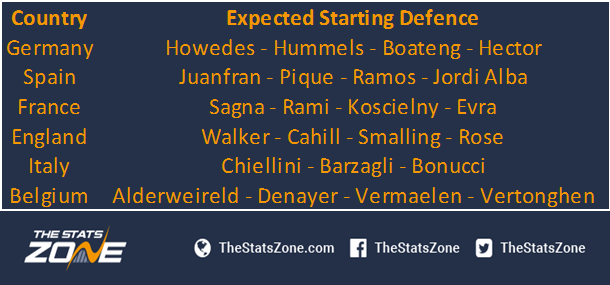
With the exception of Italy’s 3-5-2 tactic, all the top contenders for the title are going to play with four defenders. Germany might be on a similar case to Belgium due to Benekidt Höwedes’ natural position as a center back, but the rest of the teams play with a classic defensive system of two CBs and two fullbacks.
Is that going to be an advantage? Tough to say before the ball starts rolling. But if the track record shows any sign, Belgium shouldn’t be affected for their lack of fullbacks in a squad that’s loaded with talent.


