
· Tom
Fergie’s Disciples – An Analysis Of Ex-Players Into Management
Sir Alex Ferguson is one of the most successful and best known football managers in the history of the game. Indeed, his 27-year reign at Manchester United brought unparalleled levels of success to a club largely starved of glory for the best part of the previous two decades.
This success can at least in part be put down to the fact that many of his best United teams were built around strong characters who consistently drove the team forward to greater feats. Think of United during these years and it is impossible not to think of totemic figures such as Bryan Robson, Steve Bruce, Roy Keane, and Mark Hughes. These players – and many others who also played under Ferguson – have since moved into management following the end of their playing careers, no doubt aiming to put their undoubted leadership qualities into effect. In addition, four (Gordon Strachan, Mark Hughes, Laurent Blanc and Bryan Robson) have gone on to manage internationally, whilst others have provided assistant roles in this respect.
But how have they fared, and has a tutelage under one of the most successful managers in history led to a successful managerial career for themselves? In this article we will examine players who have played under Sir Alex Ferguson at Manchester United and who have subsequently gone into management, looking at how successful they have been once they have embarked upon this journey. In order to do this we will examine the number of games managed by these Ferguson graduates along with analysing their win percentages and the trophies and successes they have enjoyed in management. Ultimately, we will attempt to ascertain whether it is indeed possible to learn from the ‘master’.
Moving into management
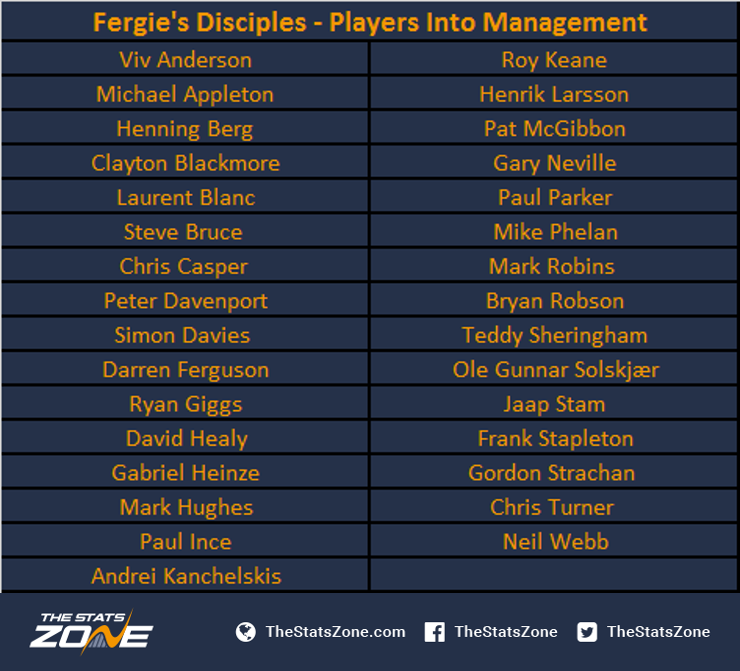
We first consider the actual numbers in terms of how many players who have played under Ferguson at United have ended up entering the world of management. In this respect, the figures are startling with Jaap Stam – upon his appointment as Reading manager in the summer – becoming the 31st Sir Alex Ferguson era player to manage a professional club. Of course, the length of Ferguson’s reign means that it is a large pool of talent, but even so, it is clear that many players appear to have been inspired into management by working under Ferguson:
Games Managed
Having noted the sheer number of former United players to have followed Ferguson into management, we now move on to examine the number of games they have actually managed. This gives a good initial marker of success given those who have performed well will tend to have had long careers, whilst others who have been less successful tend to have drifted into obscurity. We looked at the top 15 in terms of games managed. It should be noted that we did not count games managed in non-league football and in the cases of Pat McGibbon and Peter Davenport their spells in charge of semi-professional Lurgan Celtic and Bangor City respectively:
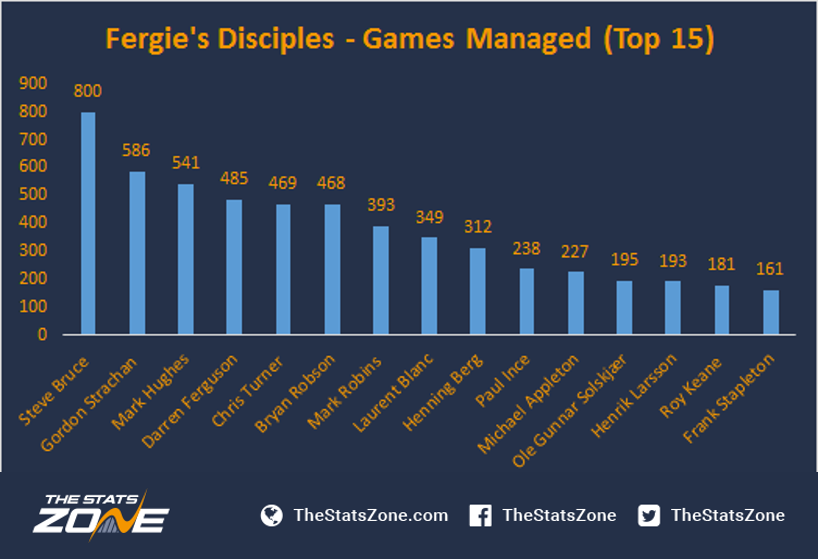
There have clearly been a number of former players who have had long managerial careers. Indeed, the top three of Steve Bruce, Gordon Strachan and Mark Hughes have racked up an impressive 1927 professional games between them, evidencing a clear staying power. Similarly, perhaps some of the lesser known Ferguson disciples such as Chris Turner, Mark Robins, and Michael Appleton have also been managers for a large number of games, suggesting that it isn’t just the “big names” who have forged long careers.
However, it was also apparent that the numbers begin to drop off quite sharply. Indeed, if we look at the data outside the confines of this graph, we see a different story; none of those from 20th – 31st have managed more than 35 games for a professional league side. It is also worth noting that of those from 16th place onwards, only David Healy and Jaap Stam are currently in work so it is perhaps unlikely that many of the others will increase their numbers, particularly in the near future. Is this perhaps pointing to a pattern that many former Ferguson players have tried management but have not achieved the results or had the requisite staying power to make long careers for themselves?
Overall win percentage
Having seen the significant discrepancy between the number of games managed by those at the top of the list and those further down, we decided to see how the managers have actually fared by analysing their win percentages. As we discuss above, it may be that many of those who have tried management have not been successful enough to forge long careers. Again, we looked at the top 15 in terms of games managed and examined their respective win percentages in those matches:
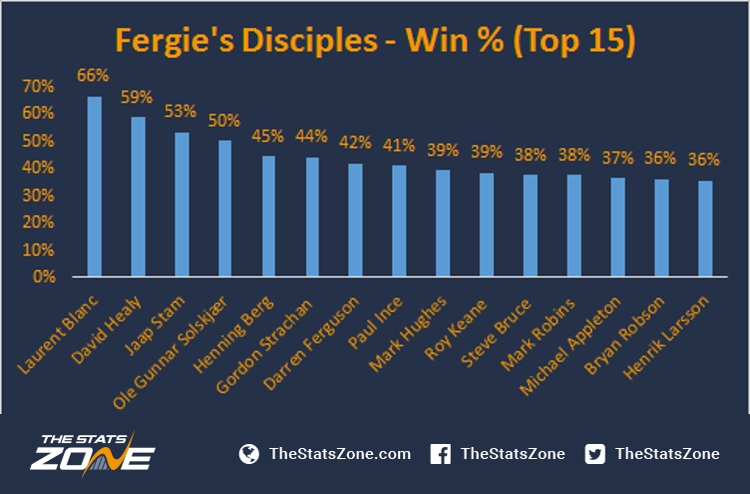
In terms of win rates, there is a clear winner with Laurent Blanc achieving a staggering win percentage of 66% across his spells with Bordeaux, Paris Saint-Germain, and France. To put this figure in some sort of context, across his remarkable 1500 game spell as manager of Manchester United, Sir Alex Ferguson achieved a win percentage of 60%. Of course, Blanc has been helped greatly by the quality of the teams he has managed with Paris Saint-Germain in particular being an almost completely dominant domestic force in France in recent years. However, with this hugely impressive win rate it is perhaps unsurprising Blanc has been mentioned in dispatches as perhaps one day following in Ferguson’s footsteps into the Old Trafford dugout. In terms of the other managers, both David Healy at Portadown and Jaap Stam at Reading have made promising starts to their careers and can perhaps hope their careers do not follow the same path as the man in fourth position – Ole Gunnar Solskjær, whose win percentage is heavily boosted by a dominant initial spell at Molde before a disastrous and short lived spell at Cardiff which significantly disrupted what appeared to be a promising career in management. As for those managers who featured at the top of the games managed list such as Steve Bruce, Gordan Strachan, and Mark Hughes, Strachan is out in front at 44% - no doubt boosted by his spell in charge of Celtic – whilst Hughes and Bruce have enjoyed remarkably similar win percentages at 39% and 38% respectively. Whilst these win percentages are perhaps not as high as one might expect for managers who have clearly enjoyed enough success to have long careers in the games, consideration does need to be given to the fact that they have often managed lower to middle ranking clubs rather than the genuine big hitters. Indeed, when analysing these figures it is worth considering the level the managers are operating at as it is no doubt true that games managed in the Premier League may be harder to win than those managed in other less competitive leagues, particularly those abroad.
Premier League record
As a result, we move on to look at the Premier League record of the managers who have played under Ferguson:
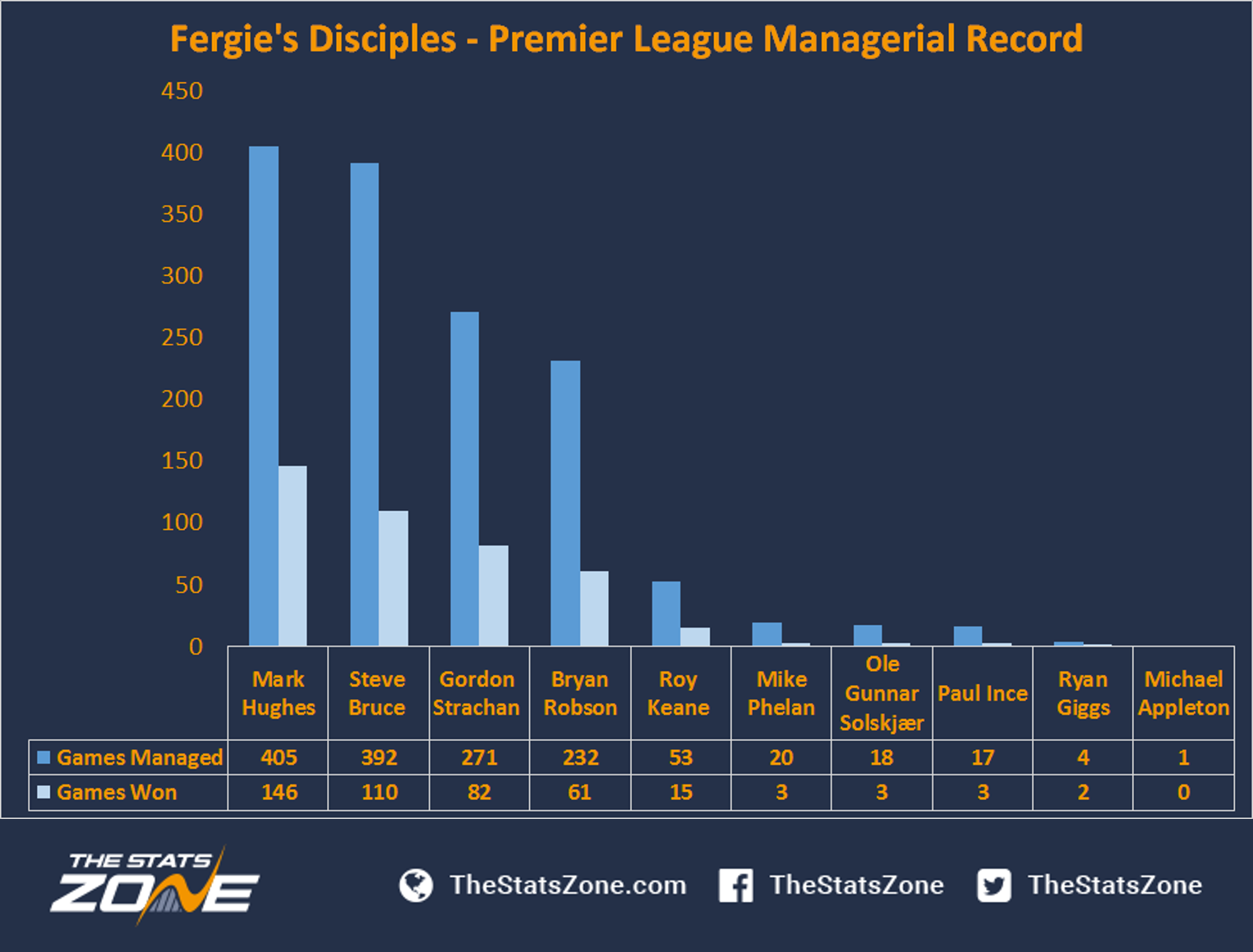
The first thing immediately apparent is that just 10 of the 31 names on our list have managed in the Premier League. Of course, whilst it is possible to have a stellar management career without managing in the Premier League (Laurent Blanc being an example), it is fair to say that in most cases, the fact that many of the managers have not graduated to managing in the Premier League is more indicative of a lack of success rather than having a great management career elsewhere. The statistics are even starker when it is considered that five of the 10 to have managed in the Premier League (Phelan, Solskjær, Ince, Giggs, and Appleton) have only done so for a combined total of 60 games, winning a mere 11. In mitigation, both Appleton and Giggs were acting as caretaker manager, but the fact remains that – with the exception of the stalwarts Mark Hughes, Steve Bruce, Gordan Strachan, and Bryan Robson – longevity in the top flight of English football has been difficult to come by for managers who played under Sir Alex.
Premier League win percentages
We then moved on to look at how the managers who have managed in the Premier League compare to Ferguson himself by comparing their Premier League win percentages to his:
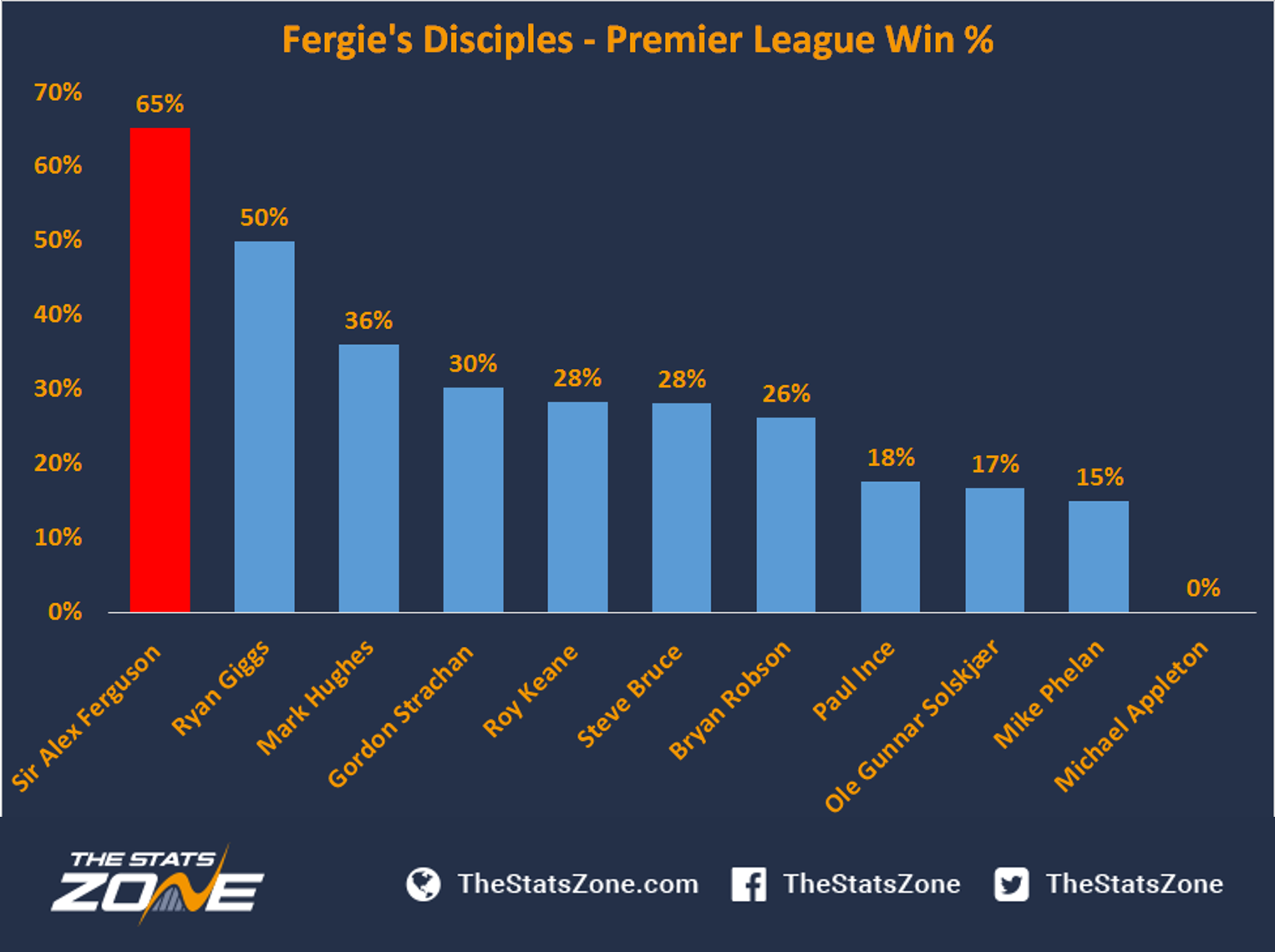
Unsurprisingly, none of the managers come close to Ferguson’s incredible 65% Premier League win percentage. Indeed, ignoring Ryan Giggs’ 50% win rate from the 4 games he took charge of, the next highest win percentage comes from Mark Hughes whose win percentage is less than half of Ferguson’s. Whilst consideration must again be given to the clubs these men have managed – and the differing expectations this results in – the statistics, as well as again reinforcing Ferguson’s brilliance, suggest that those former players who have followed him into management have struggled to replicate their former mentor’s incredibly high standards.
Promotions and trophies
Having looked at some statistical markers of success such as longevity, win percentages, and Premier League records, we now look at definable team success in terms of trophies and promotions. After all, these should provide a further marker as to the extent to which these managers can be deemed to be successful:
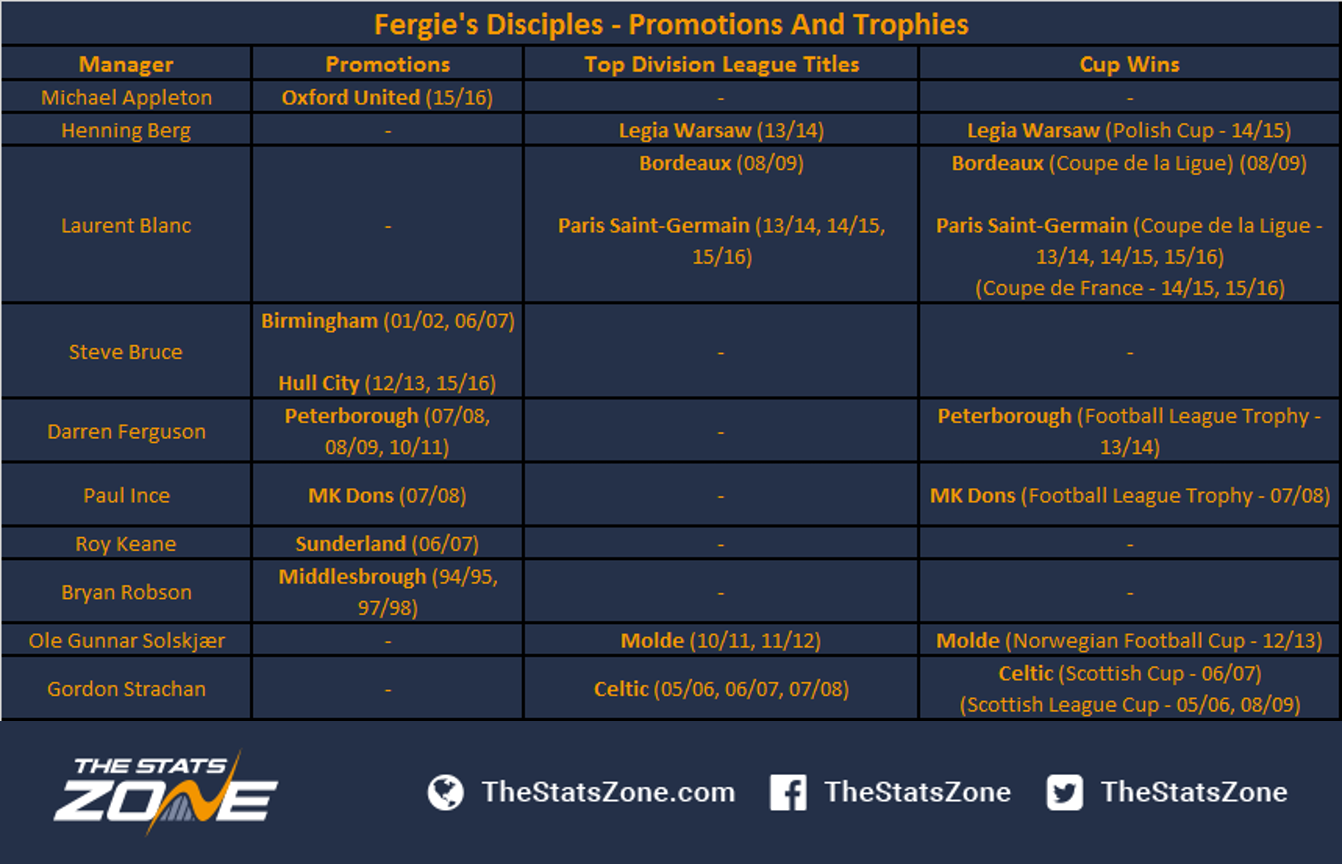
We can see that out of the 31 former Manchester United players who played under Ferguson, there are 10 who have won at least one trophy or promotion. Again, on paper at least, the most successful manager is Laurent Blanc who won the league and cup double with Bordeaux before three trophy-leaden years at Paris Saint-Germain. Similarly, Solskjær and Strachan enjoyed their most successful spells as manager at Molde and Celtic respectively, claiming both league and cup triumphs. The promotion statistics also make interesting reading as it can be spotted immediately that a number of these managers have enjoyed a good degree of success in this regard. Indeed, Ferguson’s son Darren has been promoted three times as manager, including in consecutive seasons in 2007/08 and 2008/09, whilst Bryan Robson took Middlesbrough to the Premier League twice in 1994/95 and 1997/1998. In addition, Steve Bruce can be seen to be something of the king of promotion, as he has been promoted to the Premier League on no fewer than four separate occasions with two different clubs, which suggests that Aston Villa have made a wise appointment in their bid for an immediate return to the Premier League. It is also worth noting that both Bryan Robson and Steve Bruce are losing cup finalists as managers – in Robson’s case on three occasions.
Conclusion
Having considered the data, what conclusions can be drawn about Sir Alex Ferguson’s legacy in terms of spawning successful managers? Firstly, the numbers speak for themselves in terms of his former players who have at least dipped their toes into the world of management. Even considering the length of his tenure, 31 is an impressive number and one that will no doubt rise as his last group of players approach retirement. Indeed, it is not hard to imagine Michael Carrick or Patrice Evra trying their hands at management in the near future. Whilst the sheer number of former players following him into management will no doubt be a source of pride for Sir Alex, it is fair to say that their actual success may have been a disappointment. In terms of longevity, win percentage, and trophies won, there are only really a handful of players who have achieved successful careers. Even then – and not withstanding sterling work with less glamourous clubs by the likes of Mark Hughes and Steve Bruce – the only former player whose record would suggest a genuine chance of following Sir Alex into the United dugout would be Laurent Blanc. Blanc’s impressive stats in terms of both win percentages and trophies won, as well as experience with a club expected to deliver results, make him the standout manager of the players who have played under Sir Alex. Of course, given Blanc only played under Ferguson for two years at the twilight of his career, it could be argued that Fergusons influence on him may have been limited.
It therefore seems that whilst Sir Alex Ferguson may well have inspired many players – and a number of coaches as well – to seek to emulate his achievements by embarking upon managerial careers, very few have even come close to matching the great man. Unless we see a resurgence from the likes of Gary Neville and Ryan Giggs, or the emergence of a manager from one of Ferguson’s last great teams, it appears the apprentices will never live up to the master.


