
· Tom
The Ashes Series: First Test Day 1 Analysis
After all the hype, the first day of the opening Ashes Test at The Gabba produced an outcome at once in-keeping and simultaneously out of sorts with recent Brisbane five-dayers. The Stats Zone picks through the bones of what happened and uses the stats to suggest what might come next.
Bowlers made to graft
England fans were euphoric for the most part of the first two sessions, with Mark Stoneman and James Vince largely on top in amassing a second-wicket partnership of 125, which eclipsed any Test Match stand made by the tourists on their previous trip Down Under in 2013-14. Even though Australia fought back to capture the final session and make an even day of it, seeing only four wickets fall in an opening day at The Gabba isn’t unusual in recent daytime Tests on the ground in this decade, as the table of wickets per day below identifies:
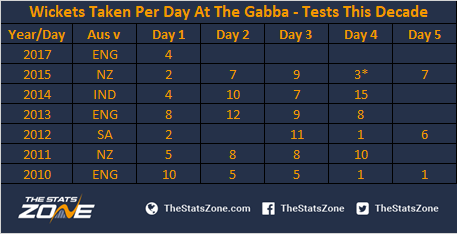
*Day heavily affected by rain
For fair statistical comparisons, we have removed the 2016 Test against Pakistan, which was a day-night affair in Queensland. Even taking that out of the equation, the average haul of tumbling wickets had been 4.2 over the five previous matches, an average bolstered by the eight Aussie scalps taken by England on their last tour.
Run rates have been considerably higher in previous seasons but despite the slower nature of the pitch when compared with the norm on this ground, the recent statistics tell us that the second day is better for the bowlers, with an average of 9.66 wickets falling on Day 2 over the last three Tests here. That may bode well for Joe Root’s side even with only 196/4 on the board, although making up lost time on the second day will naturally make for more chance to advance the match.
Results still favourite
This decade, only two of the six daytime Tests in Brisbane have ended in draws, despite the batsmen so regularly dominating the opening day of play, so the recent stats favour a win for either side as the likely outcome.
Of those two stalemates, the pitches against South Africa (2012; a match which had the second day abandoned without a ball bowled due to rain) and England (2010) were both comparable to the deck for this match but still, there has been enough sporting life in the surface to bring all bowlers into the match and accelerate the possibilities of a result.
That makes the contribution of England’s middle and lower order of vital importance, and so the signs are good for the visitors. Taking the South Africa series last summer as the most equable form guide of this current team, England amassed 2300 runs over the four Test matches, with 1347 (58.57%) coming after the fall of the fourth wicket (and those eight innings featured a declaration during the Third Test).
Whilst important to note the difference of conditions, attack, occasion and experience, given that England lost their captain leg-before with the score on 163, a similar contribution from the lower order would feed a total around 400; a total nobody would complain about as an opening gambit in such a tight series.


