
· Tom
UEFA Champions League Group Stages – Increasing Margins Of Victory
As the goal fests for Chelsea and PSG illustrated during last night's UEFA Champions League curtain-raiser, there has never been a better time to be a forward at one of European football’s powerhouses participating in the UEFA Champions League. Goal-sprees during the group stage have gone through the roof over the past four seasons, delighting an ever-growing global audience and giving punters value for money on the handicap betting market.
When the rebranded UEFA Champions League first boasted a group stage in 1992/93, it only consisted of eight clubs and the action was highly competitive. Back then, only two matches were won by four clear goals or greater, one of them thanks to a Marco van Basten solo show for AC Milan against IFK Gothenburg and the other, for eventual winners Marseille, who thrashed CSKA Moscow 6-0.
The 8.3% return for four-goal plus winning margins was replicated the following season, but the regularity of them dipped over the following years as the competition expanded to 16 clubs in 1994/95, then to 24 clubs in 1997/98 and then to its current number of 32, in 1999/2000, establishing itself as the leading competition in the world game.
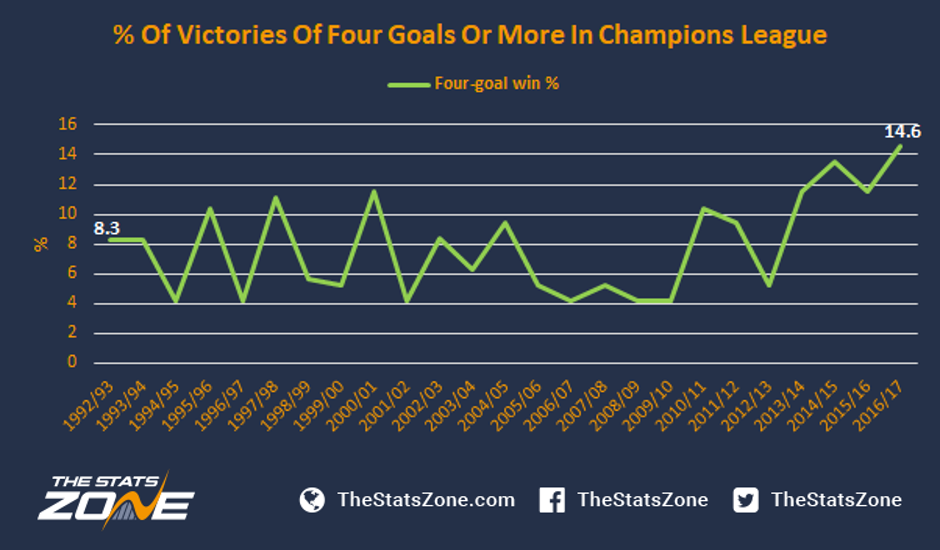
Since 1999/2000, there have been 96 matches in the initial group stage of the UEFA Champions League (we have not included into this study, the seasons where a second group stage also featured) and as the graph shows, last season brought a record number of victories by this margin, with 14 in total.
The overall trend has been positive as well, with more than 11.5% of matches each season in the group stage ending with such a hammering for four consecutive seasons.
There are many factors at play which can explain the phenomena:
- Expansion and exposure: Whilst the Champions League has long featured 32 clubs, the development of a champions path and a league route under Michel Platini to spread the wealth, interest and exposure to ‘smaller’ national associations has exposed new clubs to the big boys.
- Strengthened squads: The transfer window has long promoted a hoarding of talent among the big boys, who are becoming harder to match in the competition. Last season, Barcelona added to this tally in each of their home games by scoring an aggregate of 15 goals without reply as a case in point, particularly surprising when two of those opponents were from the English Premier League (Manchester City) and the German Bundesliga (Borussia Mönchengladbach); perceived to be from strong domestic championships.
- Ronaldo and Messi: No analysis of Champions League goals would be complete without reference to the two superstars of the era. The pair have helped themselves to an incredible 90 goals over the past four campaigns (not including the current campaign), with some flat-track bullying in the group stage thrown in for good measure.
So, when you are sizing up your predictions for this season’s group stage, it should be more a case not of who wins the matches, but by what margin they will do so.


